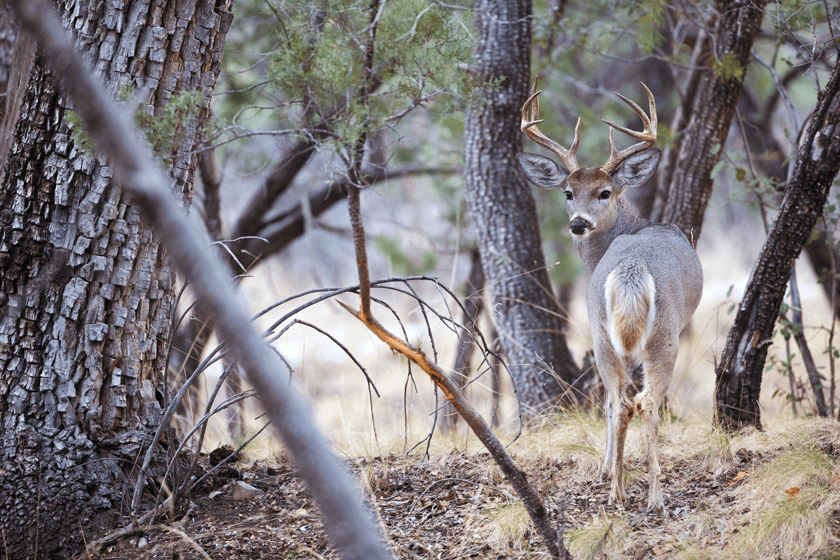
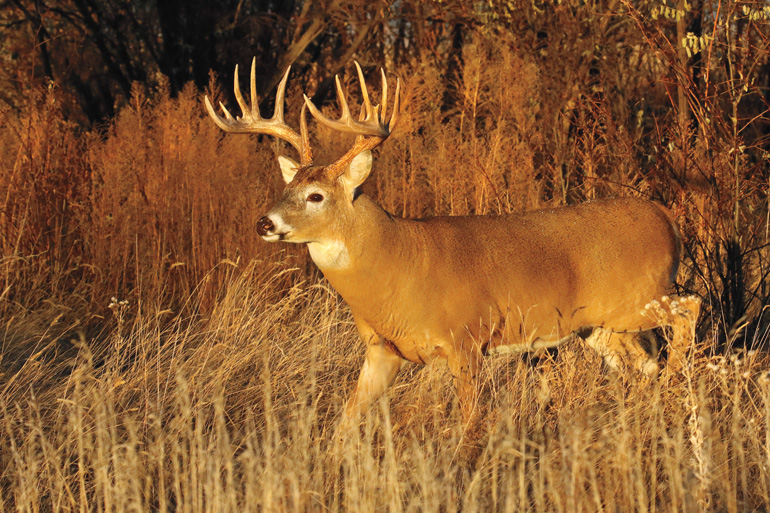
Will a whitetail buck avoid silhouetting himself by not walking a ridgetop? My brother, Barry, and I have debated this question for decades. He believes whitetails know they have a silhouette and will avoid skylines or the crests of wooded ridges during dusk and dawn hours. I don’t buy it. All deer absolutely pay attention to moving silhouettes and react to unidentified movement accordingly, but I don’t believe they can reason well enough to know they have their own silhouette. Obviously, one of the biggest mistakes a hunter can make while hunting species like wild sheep or pronghorns is to silhouette themselves. If deer could talk, they would probably laugh at some of the things we give them credit for. In my opinion, a lot of “overthinking” takes place by modern whitetail hunters. Sitting in blinds or stands for countless hours gives us time to think, but people need to think more from a deer’s perspective than our own. Much of what deer do involves no reasoning, but should instead be credited to pure behavioral instincts. Any prey species’ ability to survive and learn increases with age and experience. Longevity also depends on teaching from their mothers. I feel the whitetails we hunt today are smarter than those hunted a century ago. Adaptability to their environment is a trait: A genetic characteristic inherited by whitetails. These traits are actually what makes them so challenging to hunt. Not to belittle the species in any way, but I feel we humans give deer more credit than they deserve. A whitetail’s life is governed by only three basic things: hunger, security, and sex. Boredom and curiosity are two other factors we’ll save for another study. I’ll use examples of other species in this article. Certain animals and species have the ability to remember specific events. A variety of species are able to make rational decisions — right or wrong. Some have the ability to use tools and solve problems. A chimp will quickly learn that a square peg doesn’t fit into a round hole. Wild chimps use tools (rocks) to open nutshells. They use sticks to poke into holes smaller and deeper than their hands or arms. A wide variety of animals like elephants, canines, pigs, and ravens regularly engage in decision-making. I once watched a crow catch nightcrawlers from my lawn every bit as efficiently as any robin. An unarmed person can get a lot closer to crows than someone carrying a gun. No shot needs to be fired. Crows and ravens will quickly fly away from anyone carrying a firearm. Impressive! The difference between “thinking” and “reasoning” needs to be defined. Look up “sentient” in the dictionary. It’s defined as “the ability to perceive or feel things.” Almost every conscious being, man or beast, has some level of ability to feel emotion, form attachments, experience pain/pleasure, or detect unseen danger. Many have distinct personalities among their own species. That fact is often misused, abused, or misunderstood, thus establishing a belief that animals are little different than humans. That is simply not true. Animals can be sad or in pain, but most don’t shed tears, even though they have tear ducts to lubricate their eyes. I’ve heard examples of pets in sadness or pain shedding tears. The big difference is that man has a soul. Souls are spiritual. They encompass character, consciousness, memory, perception, reasoning, and more. Nonhumans don’t have beliefs. I won’t go so far as to say animals don’t have souls or display emotions at all, but human souls are rational and at an entirely different level above most animals. What is the biggest factor that sets humans apart? In my opinion, it’s the mastering and use of language. Language is a necessary factor in the ability to understand and make rational decisions. Imagine if deer could talk and warn each other about potential danger in advance?

Archery Season
Sep 13 - Oct 3
Blackpowder
Oct 4 - Oct 17
Gun Season
Oct 18 - Jan 1
Youth Days
Sep 27 - Sep 28
Urban Archery
Jan 10 - Feb 15